You Won't Believe What Brazil's Capital Hides – A Visual Paradise
When you think of Brazil, you probably picture Rio’s beaches or Amazon’s jungle. But Brasília? Yeah, I didn’t get it either—until I saw it. This city is like stepping into a futuristic dream, all clean lines, bold architecture, and wide-open spaces. Designed by Oscar Niemeyer and Lúcio Costa, it’s a UNESCO World Heritage site that feels more like an art gallery than a capital. Far from the tropical bustle most expect, Brasília offers a quiet kind of beauty—one shaped by vision, symmetry, and modernist ideals. Let me show you why this planned city, rising from the central plateau like a mirage, is a must-see for anyone who loves design, space, and the poetry of concrete.
First Impressions: Landing in a City That Looks Like the Future
As your plane descends toward Brasília International Airport, the first thing you notice is the clarity of the sky. The high-altitude plateau, nearly 4,000 feet above sea level, bathes everything in sharp, golden light. From above, the city unfolds in precise geometric patterns—long avenues cutting through open fields, clusters of buildings arranged with mathematical intent. There are no winding colonial streets or haphazard neighborhoods. Instead, you see a city designed from nothing, a deliberate creation born in the 1950s to symbolize Brazil’s leap into modernity.
Stepping out of the terminal, you’re greeted by clean, angular architecture and wide sidewalks bordered by native grasses and flowering shrubs. The airport itself is a minimalist structure with soaring ceilings and open spaces, a preview of what lies ahead. As you ride into the city center, the scale becomes even more apparent. Avenues stretch for miles without interruption, lined with low-rise government buildings and roundabouts that resemble abstract sculptures. Unlike Rio or Salvador, where urban life spills into every corner, Brasília feels spacious—almost silent. There’s a sense of calm, a deliberate absence of clutter.
The sunlight here intensifies the contrasts—bright white concrete glows against deep blue skies, and glass facades reflect clouds like mirrors. In the early morning or late afternoon, shadows stretch long across the plazas, emphasizing the clean lines of the buildings. It’s a city built for visibility, for clarity. Even the air feels different—dry, crisp, and still. For many visitors, this is the most surprising part: Brasília doesn’t just look different. It feels like another dimension of Brazil, one where order and vision take precedence over spontaneity.
The Mastermind Behind the Vision: Oscar Niemeyer and Lúcio Costa
No discussion of Brasília is complete without understanding the two men who brought it to life. In the late 1950s, President Juscelino Kubitschek launched an ambitious plan to move Brazil’s capital inland, away from the coastal cities, to promote development in the country’s interior. He commissioned urban planner Lúcio Costa and architect Oscar Niemeyer to design a city that would embody progress, unity, and national pride. What they created was nothing short of revolutionary.
Lúcio Costa won the master plan competition with a design shaped like an airplane—or, as some say, a bird in flight. The “fuselage” became the Monumental Axis, a broad east-west corridor housing government buildings and administrative centers. The “wings” formed the Residential Axis, where uniform superblocks provided housing for civil servants and families. This separation of functions—living, working, and governing—was central to modernist urban theory, inspired by architects like Le Corbusier. Costa’s plan was not just practical; it was symbolic, a representation of Brazil soaring into the future.
Oscar Niemeyer, meanwhile, gave the city its soul. A pioneer of modernist architecture, Niemeyer believed concrete could be poetic. He rejected rigid geometry in favor of flowing, organic curves. His buildings—cathedrals, palaces, cultural centers—look like sculptures as much as functional spaces. The use of reinforced concrete allowed for dramatic cantilevers, sweeping arches, and domes that seem to defy gravity. Together, Costa and Niemeyer fused idealism with innovation, creating a capital that was both a political statement and an artistic triumph.
Their work reflected a moment of optimism in Brazilian history—a belief that design could shape society, that beauty and function could coexist, and that a new city could inspire a new national identity. Today, their legacy lives on not just in the buildings, but in the way Brasília continues to challenge our expectations of what a city can be.
Praça dos Três Poderes: Where Power Meets Art
At the heart of Brasília’s Monumental Axis lies the Praça dos Três Poderes, or Square of the Three Powers. This vast, open plaza is where Brazil’s executive, legislative, and judicial branches converge, both physically and symbolically. Designed as the city’s political and visual centerpiece, it’s a space where architecture speaks as loudly as policy. The surrounding buildings—each designed by Niemeyer—are not just offices; they are monuments to democracy, crafted with theatrical precision.
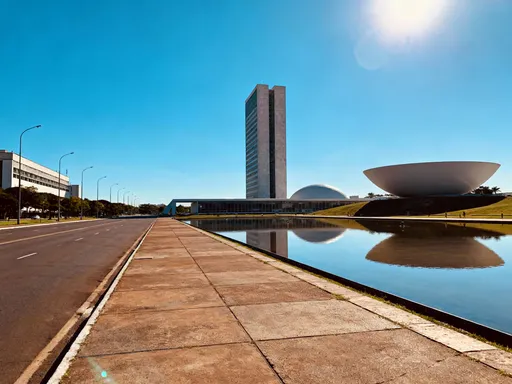
On one side stands the National Congress, its twin towers rising like sentinels, flanked by a large dome for the Senate and a smaller, inverted dome for the Chamber of Deputies. The contrast between the two hemispheres is striking—a visual metaphor for balance and duality. Nearby, the Palácio do Planalto, the presidential workplace, features slender columns and a canopy-like roof that floats above the entrance, suggesting transparency and accessibility. Across the square, the Supreme Federal Court is a symmetrical masterpiece, its colonnaded façade exuding dignity and restraint.
What makes the plaza so powerful is not just the architecture, but the space itself. Unlike capitals where government buildings are tucked into dense urban fabric, Brasília’s leaders work in full view, surrounded by open sky and reflective pools. The water mirrors the buildings, doubling their grandeur and creating a sense of stillness. In the center of the square stands the symbolic statue of Justice, blindfolded and holding her scales, mounted on a tall pedestal. There are no fences, no barricades—just an invitation to walk among the institutions of power.
Visitors often describe a sense of awe upon entering the plaza. It feels both imposing and serene, like a stage set for national ideals. On weekdays, you might see civil servants in suits walking between meetings, but on weekends, the area becomes a place for families, photographers, and tourists. The absence of noise and traffic enhances the experience, allowing you to absorb the scale and symbolism at your own pace. It’s a rare example of political architecture that doesn’t intimidate, but invites contemplation.
Cathedral of Brasília: A Spiritual Masterpiece in Concrete
One of the most unforgettable experiences in Brasília is stepping inside the Cathedral of Our Lady Aparecida. From the outside, it appears as a crown of concrete curves, sixteen hyperboloid columns rising upward and converging at the top. The structure stands at ground level, with the main entrance descending a gentle staircase into the sanctuary below. This intentional design creates a sense of transition—from the secular world above to the sacred space below.
But it’s inside where the cathedral truly transforms. Above, a stained-glass ceiling glows with vibrant blue, green, and ochre light, illuminating the entire space like a sunrise. The glass, arranged in a geometric pattern, filters the sunlight and casts a spiritual aura across the white marble floor. Suspended from the ceiling are four angelic figures, sculpted by Alfredo Ceschiatti, each floating in midair as if caught in a moment of divine motion. Their robes flow, their wings outstretched, creating a sense of movement in an otherwise still environment.
The altar, placed at the center, is simple yet powerful—a bronze baldachin supported by slender columns, with a wooden crucifix behind it. There are no side chapels or ornate decorations; the focus is entirely on light, space, and form. Unlike traditional cathedrals filled with statues and gilded details, this one relies on minimalism to evoke emotion. Many visitors report a profound sense of peace upon entering, often falling silent as they take in the atmosphere.
Niemeyer, an atheist, once said he wanted to create a space that moved people, regardless of faith. In that, he succeeded. The cathedral is not just a place of worship; it’s a work of art that transcends religion. Whether you’re spiritual or not, the experience of standing beneath that luminous ceiling, surrounded by flowing curves and floating angels, is nothing short of transcendent. It’s a testament to how architecture can elevate the human spirit.
The Pilot Plan and the Superblocks: Living in the Future
While the Monumental Axis dazzles with its grandeur, Brasília’s residential areas reveal the everyday reality of life in a planned city. The Pilot Plan, as Costa’s original design is called, organizes housing into superblocks—self-contained neighborhoods arranged along the Residential Axis. Each superblock consists of identical apartment buildings, typically four to six stories high, arranged around central green spaces. These courtyards host playgrounds, sports courts, and community gardens, offering residents a shared oasis.
The design prioritizes order, safety, and efficiency. Cars travel on perimeter roads, while pedestrians move freely within the superblocks, creating a quiet, traffic-free environment. There are no street vendors, no corner stores, no bustling sidewalks. Instead, commercial activity is centralized in the “shoppings”—local malls located at designated intervals. This separation of functions was meant to eliminate urban chaos and promote a harmonious lifestyle.
For many, this system works well. Families appreciate the safety, the green spaces, and the sense of community that develops within each superblock. Children play freely, neighbors gather in the courtyards, and the pace of life remains calm. Yet, the design also has its critics. Without mixed-use streets, there’s little spontaneous interaction. The lack of street life can feel sterile, even isolating. Some say Brasília was built for cars, not people, and that walking long distances under the hot sun isn’t always pleasant.
Over time, residents have adapted. Informal markets pop up on weekends. Cafés open in ground-floor apartments. Community associations organize events to bring people together. While the original vision was rigid, the human spirit has introduced warmth and flexibility. Today, the superblocks remain a fascinating experiment in urban living—one that continues to evolve as the city grows.
Hidden Gems Beyond the Monuments: Local Parks and Cultural Spots
While the official landmarks draw the most attention, some of Brasília’s most beautiful spaces lie just off the main axes. One of the most delightful is Burle Marx Park, named after the renowned Brazilian landscape architect Roberto Burle Marx. Spanning over 150 acres, the park features undulating pathways, reflective pools, and vibrant plantings arranged in bold, artistic patterns. Fountains dance in rhythm, and shaded benches invite quiet contemplation. It’s a living canvas, where nature and design merge in perfect harmony.
Another must-visit is the Juscelino Kubitschek Memorial, dedicated to the president who made Brasília possible. The memorial combines architecture, multimedia exhibits, and outdoor sculpture gardens to tell the story of the city’s creation. The building itself is sleek and modern, with glass walls that reflect the surrounding landscape. Inside, interactive displays offer insights into the political and social context of the 1950s, while personal artifacts humanize the historical narrative.
For culture lovers, the Cultural Complex of the Republic is a highlight. Located near the National Congress, it houses the National Museum of the Republic and the National Library. The museum hosts rotating art and history exhibitions, while the library contains over 300,000 volumes and offers reading rooms with panoramic views. The complex also includes a large amphitheater and open plaza, often used for concerts, festivals, and public events. Unlike the formal spaces of the Monumental Axis, this area buzzes with creative energy.
These sites offer a different side of Brasília—one that’s accessible, engaging, and full of life. They prove that the city is not just about grand statements, but also about daily beauty and cultural expression. Best of all, they tend to be less crowded, allowing for a more personal, reflective experience.
Why Brasília Deserves More Attention – And How to Experience It Right
Despite its architectural significance, Brasília often gets overlooked by international travelers. Most tourists head straight to Rio, São Paulo, or the Amazon, missing out on one of Brazil’s most unique destinations. Yet, for those who appreciate design, history, and quiet elegance, Brasília offers something no other city can match. It’s not about beaches or nightlife. It’s about space, symmetry, and the power of human imagination.
To truly experience Brasília, you need to slow down. Rushing through the landmarks in a single afternoon won’t do it justice. Instead, plan for at least two full days. Begin with a guided van tour of the Monumental Axis—many hotels and cultural centers offer informative circuits with commentary on Niemeyer and Costa’s work. In the late afternoon, visit the Cathedral when the sunlight streams through the stained glass, creating a magical interior glow.
For a more active exploration, rent a bike. The city has dedicated bike lanes, and cycling allows you to appreciate the scale and rhythm of the urban design. Morning rides through the superblocks reveal daily life in motion—neighbors chatting, children playing, birds flitting through native trees. Stop by a local café in one of the shoppings to try regional dishes like pequi rice or empadas filled with heart of palm.
The best times to visit are during the dry season, from April to September, when the skies are clear and the temperatures mild. Early morning and late afternoon offer the best light for photography, especially at the Praça dos Três Poderes and the Cathedral. Don’t forget comfortable walking shoes—while the city is spread out, the open plazas and long avenues require plenty of steps.
Most importantly, come with an open mind. Brasília challenges expectations. It doesn’t offer the sensory overload of coastal cities. Instead, it invites reflection. It’s a city built not for spectacle, but for meaning. Every curve, every plaza, every beam of light was placed with intention. To see Brasília is to witness a dream cast in concrete—one that continues to inspire, provoke, and surprise.
Brasília isn’t just a capital—it’s a bold statement in concrete and glass, a city built on dreams. While it lacks the chaos of coastal Brazil, it offers something rare: space, silence, and architectural wonder. For travelers who appreciate design and stillness, it’s a revelation. Don’t skip it. Let Brasília surprise you, just as it surprised me.