Snap Me If You Can: New Orleans’ Most Photogenic Corners Uncovered
New Orleans isn’t just a city—it’s a living canvas. From the iron lace of French Quarter balconies to the vibrant murals in Bywater, every neighborhood tells a story through color, light, and texture. As a traveler with a camera in hand, I discovered that the soul of this city reveals itself in its most photogenic pockets—places where culture, history, and art collide in perfect frames. This is where moments become memories, one shot at a time. With every shutter click, a deeper connection forms, not only to the place but to its people, rhythms, and unspoken traditions. Photography here is less about perfection and more about presence.
The Magic of Seeing New Orleans Through a Lens
Photography transforms the way we travel. It shifts our attention from simply passing through to truly observing. In New Orleans, this shift is especially powerful. The city does not reveal itself all at once; it unfolds in fragments—a flicker of gold in a wrought-iron scroll, a child’s laughter echoing off cobblestones, the way morning fog clings to live oaks like gauze. These are the details that cameras catch, moments often missed by the casual eye. When you carry a lens, you begin to notice how light dances across stucco walls in the late afternoon or how shadows stretch like fingers across Royal Street just before dusk.
What makes New Orleans so uniquely photogenic is its layered identity. It is a city shaped by centuries of migration, resilience, and celebration. Every building, mural, and street corner carries a trace of history, whether in the Spanish colonial architecture of the French Quarter or the Creole cottages of Treme. The city’s rhythm—slow, soulful, and syncopated—invites photographers to slow down too. Instead of rushing from landmark to landmark, you find yourself pausing, waiting for the right moment: a streetcar gliding past a mural, a woman in a floral dress stepping out of a shotgun house, a jazz note hanging in the humid air.
For family women traveling, often balancing caregiving with personal discovery, photography offers a rare kind of mindfulness. It allows you to engage deeply with your surroundings while creating lasting keepsakes. A photo of your daughter laughing in front of a rainbow-painted house in Bywater, or your husband leaning against a moss-draped tree in City Park—these images become heirlooms. But beyond the personal, photography in New Orleans becomes an act of witness. You’re not just capturing beauty; you’re honoring a culture that has thrived through hardship, music, and community.
French Quarter: Where Every Balcony Has a Story
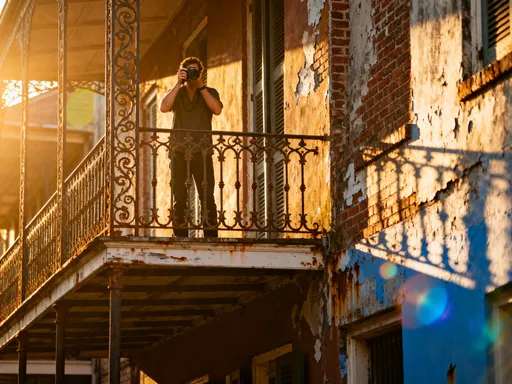
No visit to New Orleans is complete without wandering the French Quarter, and no lens is idle here. This historic district, established in 1718, is a masterclass in architectural storytelling. The wrought-iron balconies, often draped with bougainvillea, are not merely decorative—they speak of romance, of slow evenings spent sipping iced tea while watching the world pass below. Each balcony seems to lean in with curiosity, offering a glimpse into lives lived above the bustle of Bourbon Street.
For photographers, the French Quarter provides endless composition opportunities. Jackson Square, framed by St. Louis Cathedral, is a classic shot, especially at sunrise when the plaza is nearly empty and the light turns the cathedral’s spires to gold. The reflection of the building in a rain puddle can double the impact, adding symmetry and depth. Royal Street, quieter than its famous neighbor, is lined with antique shops, art galleries, and hidden courtyards. These courtyards—often tucked behind unassuming doors—are where the city’s secrets lie. A single magnolia bloom on a stone fountain, a cat curled on a windowsill, the way ivy climbs a crumbling wall—these are the quiet moments that define New Orleans.
To avoid crowds, arrive early. By 7 a.m., the streets are still cool, the light soft and even. This is the best time to capture the textures of the city: the peeling paint on wooden shutters, the patina of centuries-old brick, the way mist rises from the Mississippi River just blocks away. Use a wide-angle lens to capture the full sweep of a street scene, or a macro lens to isolate details—perhaps the rust on a gate hinge or the intricate scrollwork of a balcony railing. Reflections, whether in shop windows, puddles, or even sunglasses, add creative dimension. One photographer’s tip: look down as much as you look up. The cobblestones, worn smooth by generations of footsteps, tell their own story.
Garden District: Elegance in Symmetry and Greenery
Just a short streetcar ride from the French Quarter, the Garden District offers a different kind of beauty—one of order, grace, and lush tranquility. This neighborhood, developed in the 19th century by wealthy Americans, is a study in symmetry and contrast. Grand mansions, some with columns and porticos, stand beside rows of pastel-colored homes with white trim. Live oaks, their branches stretching across the streets, form a canopy that filters sunlight into dappled patterns on the sidewalks.
For photographers, the Garden District is a dream. The long, straight streets—Magazine, Prytania, Coliseum—create natural leading lines. A single row of picket fences, each painted a slightly different shade of white or blue, can become the subject of an entire roll of film. The interplay between architecture and nature is striking: a magnolia tree framing a Greek Revival facade, a garden gate half-hidden by wisteria, the way morning light catches the glass in a transom window. These are not just photos of houses; they are portraits of a way of life.
Because the area is residential, it’s important to be respectful. Stick to public sidewalks and avoid trespassing on private property. The best time to shoot is mid-morning or late afternoon, when the sun is low and casts long shadows. A polarizing filter can help reduce glare on windows and enhance the green of the foliage. For a more intimate feel, focus on details: a doorknob shaped like a lion’s head, a planter filled with ferns, a child’s bicycle leaning against a porch. These small moments humanize the grandeur.
The Garden District also offers excellent opportunities for portrait photography. If you’re traveling with family, consider staging a quiet moment on a bench under an oak tree or having your children pose beside a historic streetlamp. These images will carry the elegance of the neighborhood without feeling staged. And while the mansions draw the eye, don’t overlook the side streets. Some of the most charming homes are tucked away on smaller blocks, where azaleas bloom in spring and front porches invite conversation.
Bywater & Marigny: Art, Color, and Urban Soul
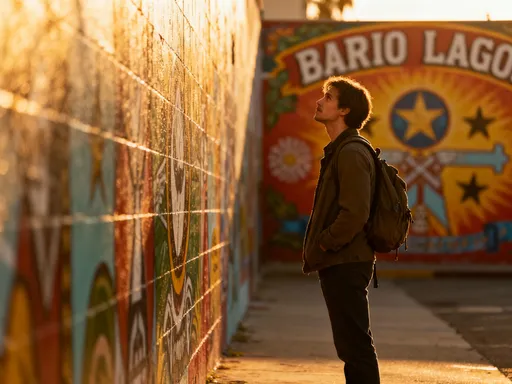
If the Garden District is a sonnet, then Bywater and Marigny are jazz improvisations—bold, unpredictable, and full of life. These adjacent neighborhoods, just downriver from the French Quarter, pulse with creative energy. Houses are painted in electric hues: tangerine, turquoise, lavender. Murals cover entire walls, depicting everything from mythical creatures to local musicians. Art installations pop up in yards—repurposed pianos, sculptures made from scrap metal, even a house that looks like it’s melting into the ground.
Bywater, in particular, has become a haven for artists, musicians, and free spirits. The Music Box Village, a playful outdoor museum where interactive musical houses invite visitors to make sound, is a favorite for families and photographers alike. Capturing children laughing as they bang on a tin roof or turn a crank that plays a melody—these are the moments that feel alive. The neighborhood’s authenticity is its greatest draw. There are no staged photo ops here, no forced charm. Instead, you’ll find roosters wandering freely, neighbors chatting over fences, and impromptu front-porch concerts where someone pulls out a guitar and starts to play.
For photographers, this is candid heaven. The challenge—and the joy—lies in staying alert. A street performer might appear around the corner, a mural might be revealed as the sun shifts, or a local artist might be painting a new piece on a garage door. Keep your camera ready. Use a fast shutter speed to freeze motion, or a slower one to blur the movement of a passing bicycle, adding dynamism to the frame. The colors here are so vivid that you may need to adjust your white balance to avoid oversaturation. But don’t be afraid of bold hues—this is a place where color tells the story.
Marigny, with its Creole architecture and Caribbean influence, complements Bywater’s wildness with a slightly more structured vibe. Frenchmen Street, known for its live music venues, comes alive at night. While nighttime photography can be tricky, the glow of neon signs, the warm light spilling from club doors, and the silhouettes of dancers create a moody, cinematic atmosphere. Use a tripod or stabilize your camera on a ledge to avoid blur. And always be mindful of your surroundings—keep your gear secure and your focus on the experience, not just the shot.
Treme: Culture in Motion
Treme is one of the oldest African American neighborhoods in the United States, and it remains a cultural cornerstone of New Orleans. This is where jazz was born, where second-line parades march through the streets with umbrellas twirling and brass bands blaring. To photograph Treme is to witness living history—but it must be done with care, respect, and humility.
Second-line parades, traditionally held at jazz funerals and community celebrations, are powerful visual spectacles. The rhythm is infectious, the energy electric. But these are not performances for tourists. They are expressions of community, resilience, and joy in the face of loss. As a photographer, your role is not to direct but to observe. Avoid blocking the parade, never touch the participants, and never ask someone to repeat a move for your camera. Instead, position yourself at the edges, use a zoom lens if needed, and let the scene unfold naturally.
Emotion is the heart of Treme photography. Look for the way a woman’s face lights up as she dances, the concentration in a trumpeter’s eyes, the way children mimic their elders’ steps. These are not just images; they are records of cultural continuity. If you’re invited to join, do so with gratitude and awareness. But never assume access. Some events are private, and that boundary must be honored.
During the day, Treme offers quieter moments: a man repairing a trombone on his porch, a mural honoring local legends like Louis Armstrong or Mahalia Jackson, a corner store with hand-painted signs. These everyday scenes are just as important as the parades. They show how culture lives in the details. When photographing people, always ask permission when possible. A smile, a nod, a simple “May I take your picture?” goes a long way. Most New Orleanians are warm and welcoming—but that warmth is earned through respect.
Practical Tips for Capturing the City Like a Pro
Great photography in New Orleans isn’t just about location—it’s about preparation. Start with timing. The best light occurs during golden hour (just after sunrise and before sunset) and blue hour (the twilight period after sunset). During these times, the city glows with a soft, warm radiance that enhances textures and colors. Midday light, especially in summer, can be harsh and unflattering. If you must shoot then, seek shade or use a diffuser.
As for gear, you don’t need the most expensive camera. Many stunning New Orleans photos have been taken with smartphones. The key is knowing your equipment. If using a mirrorless or DSLR camera, bring a versatile zoom lens (24-70mm is ideal) and a prime lens for low light (like a 50mm f/1.8). A lightweight tripod can be useful for long exposures, especially in dimly lit courtyards or at night on Frenchmen Street.
Composition matters. Use natural frames—archways, windows, tree branches—to draw the eye to your subject. Look for leading lines: a streetcar track, a row of lampposts, a fence. Include people for scale and life, but do so thoughtfully. A lone figure walking down a cobblestone alley can add mood without intrusion. Don’t be afraid to shoot in portrait orientation—many of New Orleans’ most iconic scenes, like a towering oak or a multi-story balcony, benefit from vertical framing.
Weather is part of the experience. New Orleans is humid, and rain can appear suddenly. Protect your gear with a rain cover or a simple plastic bag with a hole cut for the lens. But don’t retreat indoors at the first drop. Rain adds magic—puddles become mirrors, streets glisten, and the air feels charged. Some of the most atmospheric photos are taken in the mist.
Finally, practice ethical photography. Always ask before photographing individuals, especially in intimate or sacred moments. Respect private property—no climbing fences or entering yards without permission. And remember: not every moment needs to be captured. Sometimes, the most powerful memory is the one you keep in your mind, not on a memory card.
Why These Places Matter Beyond the Perfect Shot
At its best, photography is not about vanity or virality. It’s about connection. In New Orleans, every photo you take is a conversation—with the city, with its people, with history. The images you bring home are more than souvenirs; they are invitations to remember how you felt standing in that quiet courtyard, how the air smelled after the rain, how a stranger smiled as you raised your camera.
For women who travel, often balancing the needs of family with their own desire for meaning, photography offers a way to claim space and attention. It says: I was here. I saw this. I felt this. And I want to remember. The photos become part of a larger story—not just of a trip, but of a life lived with curiosity and heart.
New Orleans teaches us to see differently. It reminds us that beauty exists in decay, joy in resilience, and art in the everyday. When you photograph this city, you’re not just documenting what’s in front of you—you’re participating in its ongoing story. So shoot with intention. Shoot with respect. And above all, shoot with love. Because the most lasting images are not the sharpest or the most colorful—they are the ones that carry the soul of the place, and your own, within them.