Stone Giants and Sunlight: Chasing Easter Island’s Soul Through the Lens
You know that feeling when you stand before something so ancient, so mysterious, it silences your thoughts? That was me at Rapa Nui. The moai aren’t just statues—they’re guardians of a lost world. Through my camera, I tried to capture more than stone; I wanted the soul of the island. This is not just about photography. It’s about light, silence, and the stories carved in volcanic rock. You gotta see it to believe it.
First Light on Rapa Nui
The journey to Easter Island is not for the impatient. After hours of open ocean and a final descent through scattered clouds, the runway appears like a scar across an emerald island. The air is thick with salt and the scent of volcanic soil. As the plane touches down at Mataveri International Airport, the stillness outside is immediate and profound. There are no city sounds, no traffic hum—just wind sweeping across the tundra-like fields and the distant cry of a seabird. This isolation, nearly 2,300 miles off the coast of Chile, is not just geographical. It shapes the very rhythm of life here, a rhythm that echoes in every stone and every sunrise.
Rapa Nui, as the indigenous people call it, feels like a world apart—literally and spiritually. The landscape is a study in contrasts: rust-red earth, charcoal-black lava flows, and the endless, shimmering blue of the Pacific. Rolling hills rise from the coast, crowned by three extinct volcanoes. This is not a place that was built. It feels as though it has emerged—formed by fire, shaped by wind and rain, and marked by hands that understood the language of stone. The first time I walked to Tongariki at dawn, the eastern horizon glowed with a soft, golden hue. The 15 moai stood in perfect alignment, their backs to the sea, their faces catching the first light. In that moment, the island wasn’t just a destination. It was a presence.
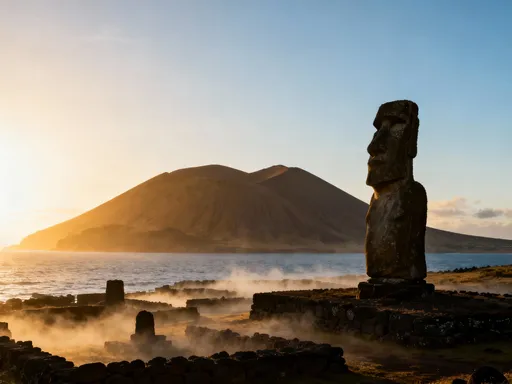
Photographing Easter Island begins with understanding this atmosphere. The moai are not theme park attractions; they are part of a sacred geography. Their placement is deliberate—oriented toward the rising sun, aligned with solstice points, and positioned to watch over ancestral lands. To capture them authentically, one must arrive early, when the light is gentle and the crowds are absent. At first light, the statues seem to awaken. Shadows stretch long behind them, emphasizing their height and solemnity. The warmth of sunrise softens the harsh textures of tuff stone, giving the figures a lifelike glow. This is not just a visual experience. It is a sensory one—cool air on the skin, the crunch of volcanic gravel underfoot, the silence broken only by the whisper of wind through the grass.
The Moai: More Than Monuments
The moai are the soul of Rapa Nui, but they are often misunderstood. These are not random statues placed for display. Each one is a representation of an ancestor, carved with intention and reverence. Most were quarried from the slopes of Rano Raraku, a volcanic crater that served as both workshop and spiritual center. The soft volcanic tuff there allowed for detailed carving, and today, hundreds of unfinished moai remain embedded in the hillside, frozen in time. Some are upright, others lie on their sides, their features partially revealed as if waiting to be born from the rock. This site alone offers endless photographic possibilities—not just of completed figures, but of the process itself, of creation interrupted.
How the Rapa Nui people moved these massive statues—some weighing over 80 tons—remains a subject of study and debate. The most widely accepted theory suggests they were ‘walked’ upright using ropes and manpower, rocking them forward in a controlled motion. This method, supported by archaeological evidence and experimental reconstructions, speaks to both ingenuity and communal effort. Photographing the moai in transit, such as those found along ancient roads, helps tell this story. A single statue lying abandoned on a slope becomes a narrative of ambition, labor, and perhaps, changing priorities.
The ceremonial platforms, or ahu, are equally significant. These stone foundations, often built along the coast, served as burial sites and places of worship. Ahu Tongariki, the largest, holds 15 moai restored after a tsunami in 1960 toppled them. Seeing them lined up against the sunrise is one of the most powerful experiences on the island. Ahu Akivi, unique for facing the ocean, is aligned with the equinox sunset, a reminder of the Rapa Nui’s deep understanding of astronomy. When composing a shot, it’s essential to include not just the statues but the ahu—the layered stonework, the placement, the relationship between earth and figure. A wide-angle lens can capture scale, while a telephoto isolates expression, drawing attention to the moai’s elongated ears, heavy brows, and solemn gaze.
Beyond the Statues: Hidden Structures and Sacred Spaces
While the moai dominate the narrative, the true depth of Rapa Nui’s architecture lies in its everyday spaces. Scattered across the island are the remains of homes, food storage units, and ceremonial sites that reveal how people lived, adapted, and thrived in isolation. The hare paenga, or boat-shaped house foundations, are among the most distinctive. Built from curved basalt stones arranged in an oval, these structures resemble upturned canoes—a nod to the seafaring origins of the Rapa Nui people. Today, only the foundations remain, but their symmetry and careful construction make them compelling subjects. Framed against the sky or half-buried in grass, they evoke a quiet resilience.
Equally intriguing are the hare moa, small stone enclosures once used to protect chickens. Though modest in size, their compact design and stacked stonework reflect a culture attuned to resource efficiency. Then there are the rukuruku, semi-subterranean dwellings carved into hillsides or lava tubes. These shelters, cool and hidden, offered protection from wind and sun. Their dark interiors, with niches for sleeping and storage, speak to a life shaped by necessity and ingenuity. Photographing these sites requires patience. Light is often low, and details emerge slowly. A tripod and longer exposure can reveal texture in shadowed corners. Shooting at an angle emphasizes depth, turning a simple stone wall into a study of form and time.
One of the most rewarding aspects of exploring these lesser-known sites is the sense of discovery. Unlike the main tourist routes, these ruins are often unmarked, overgrown, or tucked into folds of the landscape. Finding a collapsed ahu half-hidden in a field, or a cluster of petroglyphs etched into a lava boulder, feels like uncovering a secret. These moments are not about grandeur but intimacy. They invite contemplation. In photography, this translates to composition that honors decay—not as ruin, but as transformation. Cracked stone, lichen-covered surfaces, and the interplay of shadow and moss become central elements. The goal is not to restore, but to observe—to let the passage of time speak through the image.
Light as a Storyteller
If the moai are the soul of Rapa Nui, then light is its voice. The island’s dramatic skies and open horizons create ever-changing conditions that define every photograph. The golden hour—shortly after sunrise and before sunset—casts a warm, diffused glow that softens the rugged terrain. At Anakena Beach, where palm trees lean over white coral sand, this light turns the moai at Ahu Nau Nau into silhouettes edged with gold. Backlighting emphasizes their profiles, while reflections in shallow tidal pools double their presence. This is the time for wide compositions, for capturing the harmony between statue, sea, and sky.
Equally powerful is the blue hour, that fleeting window after sunset when the sky shifts from orange to deep indigo. At Orongo, the ceremonial village perched on the rim of Rano Kau crater, this light transforms the stone houses into ghostly forms. The jagged edge of the crater drops into the churning ocean below, and the remaining structures stand like sentinels in the twilight. A long exposure can smooth the waves into a misty haze, enhancing the dreamlike quality. Here, a neutral density filter helps manage the dynamic range, preserving detail in both shadows and highlights.
Storm light, though less predictable, offers some of the most dramatic opportunities. When clouds race across the sky and shafts of sunlight break through, the moai seem to emerge from shadow with renewed intensity. At Rano Raraku, such conditions highlight the textures of the quarry—deep grooves in the rock, the roughness of unfinished surfaces, the way water pools in hollows. Shooting in RAW format is essential, as it allows for greater flexibility in post-processing, especially when balancing contrasting light. But more than gear, success here depends on timing and stillness. The best shots often come after waiting—sometimes for hours—for the right cloud to pass, for the wind to still, for the light to fall just so.
Framing Culture, Not Just Stone
Photographing Easter Island carries a responsibility. These sites are not relics of a dead civilization but living parts of a continuing culture. The Rapa Nui people have endured colonization, displacement, and cultural erosion, yet they remain deeply connected to their heritage. Many sites are considered sacred, and certain areas are restricted or require permission to enter. Ethical photography means respecting these boundaries. It means not climbing on the moai, not disturbing offerings, and not treating the island as a backdrop for staged poses.
Instead, the most meaningful images often include subtle human elements. A local guide placing a wreath of ferns on an ahu. A child’s shadow stretching toward a statue at sunset. Hands tracing the grooves of a petroglyph. These moments do not dominate the frame but enrich it, reminding viewers that Rapa Nui is not a museum—it is a home. Speaking with community members, hiring local guides, and learning even a few words of Rapa Nui language can deepen understanding and lead to more authentic interactions. Many guides share oral histories that add layers of meaning to what might otherwise be seen as mere stone.
The island teaches patience. The best photographs are rarely the first ones taken. They come after sitting quietly, after listening to the wind, after letting the place settle into your awareness. A tripod is not just a tool for stability—it is an invitation to slow down. When you wait, the light shifts, the clouds move, and sometimes, a bird lands on a statue’s shoulder, adding an unexpected element of life. These are the images that endure—not because they are technically perfect, but because they carry emotion, respect, and a sense of connection.
The Island’s Palette: Colors of a Volcanic Canvas
Rapa Nui’s color palette is unlike any other. It is born of fire and sea, shaped by millennia of erosion and growth. The dominant tones are earthy and elemental: the iron-rich reds of the soil, the deep blacks of basalt, the steely grays of weathered stone. Yet, these are balanced by surprising bursts of color. The crater lakes—Rano Kau, Rano Raraku, and Rano Aroi—hold waters that shift from emerald green to sapphire blue depending on the light and mineral content. These colors, vivid against the dark rock, create natural focal points in any composition.
At sunset, the palette warms dramatically. The western coast, particularly around Tahai, glows in hues of amber, rose, and copper. The moai at Ahu Ko Te Riku, the only one with restored coral eyes, seems to watch the sun dip below the horizon with quiet reverence. Here, white balance settings can be adjusted to enhance warmth without oversaturating. Shooting in natural light without flash preserves the authenticity of the moment. In contrast, the stone village at Orongo, built from dark volcanic rock, absorbs light, creating a cooler, more somber mood. This duality—warmth and shadow, vibrancy and austerity—reflects the island’s spiritual complexity.
For photographers, this range of color offers both challenge and opportunity. The key is not to capture every shade, but to use color intentionally. A red umbrella in the grass, a blue fishing boat pulled ashore, a patch of yellow wildflowers clinging to a cliff—these accents can anchor a composition. They draw the eye and add narrative depth. At the same time, monochrome processing can be powerful, stripping away color to emphasize texture, form, and shadow. Whether in full color or black and white, the goal is to reflect the island’s essence—its contrast, its resilience, its quiet beauty.
Why This Place Changes You
Spending time on Easter Island changes something inside. It is not just the awe of seeing the moai, or the thrill of capturing a perfect shot. It is the silence. The scale. The sense of standing in a place where time feels different. The Rapa Nui people speak of mana, a spiritual energy that flows through the land and its ancestors. Whether or not one believes in such concepts, it’s hard not to feel it—especially at dawn, when the island is still, and the moai stand like sentinels between earth and sky.
This place is not static. After decades of cultural suppression, the Rapa Nui have been reclaiming their language, traditions, and autonomy. Festivals like Tapati Rapa Nui celebrate music, dance, and ancient sports. The revival of the rongorongo script, though still undeciphered, is a symbol of resilience. Photographing these moments—children in traditional dress, elders chanting, athletes competing in stone-lifting contests—adds a living dimension to the island’s story. It reminds us that heritage is not just in the past. It is being lived, renewed, and protected.
And so, photography becomes more than documentation. It becomes an act of preservation. Every image shared, every story told, helps raise awareness of this fragile place. Climate change, rising sea levels, and tourism pressures threaten the very sites we come to admire. By photographing with care—by choosing respectful angles, minimizing environmental impact, and supporting local initiatives—we contribute to the island’s survival. The moai have watched the ocean for centuries. They will likely continue to do so. But our role is not just to witness. It is to honor, to protect, and to pass on what we’ve seen.
Easter Island doesn’t give up its secrets easily. Its power lies not in spectacle, but in stillness. Through the lens, we don’t just record—we connect. The moai gaze across time, and when we frame them with care, we become part of their story. This is photography with purpose: to witness, to wonder, and to protect. The island endures. Let our images do the same.